
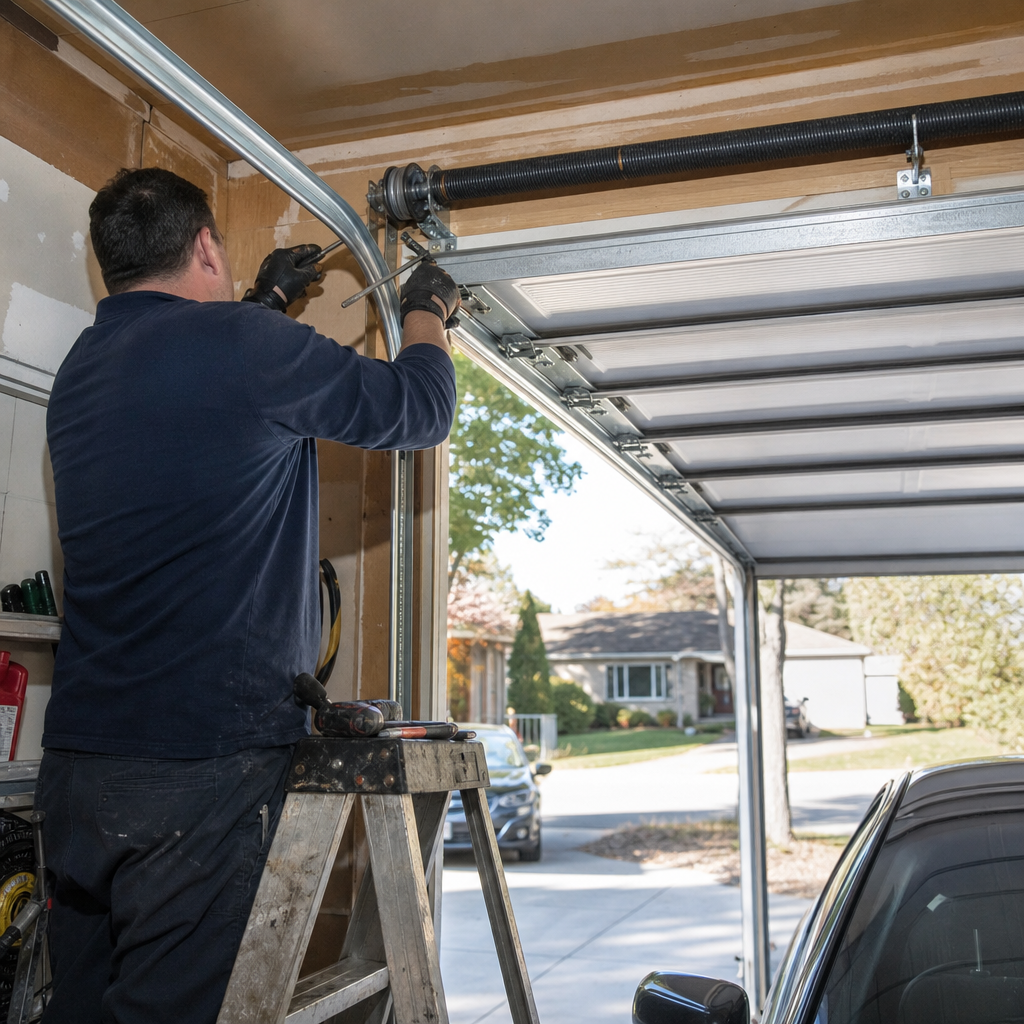
Last updated July 11, 2026
Seasonal Garage Door Care for Rochester: Year-Round Homeowner’s Guide
Rochester averages fewer than 50 days of what most people would call “mild” weather each year. That means your garage door spends roughly 315 days either fighting against freezing temperatures, heavy lake-effect snow, or recovering from the damage those conditions leave behind. Most seasonal maintenance guides treat every climate the same — a tidy spring-summer-fall-winter checklist that ignores the reality of upstate New York. In Rochester, garage door care isn’t about four equal seasons. It’s about two brutal extremes separated by two narrow windows where you can actually get ahead of problems. This guide shows you exactly when to act, what to check, and why Rochester’s freeze-thaw cycle demands a different approach than generic advice you’ll find online.
Quick Answer
Seasonal garage door care in Rochester means concentrating your maintenance effort into two critical periods: pre-winter hardening in October before the first freeze, and spring recovery in March–April after salt and cold have done their damage. Between those windows, monitor for cold-weather stress signs in mid-winter and adjust for summer humidity in June. Skip the generic quarterly schedule — Rochester’s climate punishes doors that aren’t prepared for extreme cold and rapid temperature swings.
Table of Contents
- Why Rochester’s Climate Is Uniquely Hard on Garage Doors
- Pre-Winter Prep: The October Non-Negotiables
- Mid-Winter Monitoring: Reading the Warning Signs
- Spring Recovery: Undoing Winter’s Damage
- Summer Adjustments: Humidity, Heat, and Opener Strain
- Why Rochester’s Freeze-Thaw Cycle Destroys Torsion Springs
- Common Mistakes to Avoid
- When to Call a Professional
- Frequently Asked Questions
Why Rochester’s Climate Is Uniquely Hard on Garage Doors
Most garage door manufacturers design their products for “average” U.S. conditions — roughly 30 to 90 degrees Fahrenheit with moderate humidity. Rochester laughs at that range. We regularly see single-digit January lows, 90-degree July days with 80% humidity, and temperature swings of 40 degrees within a single week during shoulder seasons. That volatility creates problems no generic maintenance schedule addresses.
The specific threats stack up fast:
- Lake-effect snow and ice accumulate at the door base, freezing the bottom seal to the concrete and straining the opener when you hit the button
- Road salt tracked into garages corrodes bottom brackets, hinges, and track hardware — we’ve replaced track sections in Park Avenue and Corn Hill homes where salt damage advanced two years faster than manufacturer estimates
- Freeze-thaw cycling causes metal components to contract and expand repeatedly, accelerating fatigue in springs, cables, and bearing plates
- Extended cold periods thicken lubricants and stiffen seals, forcing openers to work harder and drawing more amperage
- High summer humidity swells wood doors and affects electronic sensor alignment in older opener models
In our 14 years working on Rochester garage doors, we’ve noticed a clear pattern: the doors that fail catastrophically in January were almost always the ones that skipped October preparation. The homeowners who call us for emergency service in the dead of winter — and we’ve answered hundreds of those calls — typically haven’t touched their door since the previous spring, if ever.
The neighborhoods around Irondequoit Bay and along Lake Ontario’s shoreline see even harsher conditions. Wind-driven moisture penetrates seal gaps more aggressively, and the temperature moderation you’d expect near water actually works against you — it keeps surfaces damp right up until a hard freeze, creating more ice-welding events than inland areas like Brighton or Pittsford experience.
This isn’t about being alarmist. It’s about recognizing that Rochester’s climate demands a maintenance rhythm matched to its actual weather pattern, not a calendar pulled from a national home improvement magazine.
Pre-Winter Prep: The October Non-Negotiables
October is your last reliable window before Rochester’s first hard freeze, which historically arrives between October 15 and November 7. Once temperatures drop below 28 degrees for extended periods, several maintenance tasks become difficult or impossible to perform effectively. Here’s what we do on our own doors and what we recommend to homeowners across Rochester’s east side, west side, and surrounding suburbs.
Step 1: Inspect and Replace the Bottom Seal
The bottom seal is your door’s first defense against ice welding — that moment when melted snow refreezes and glues your door to the concrete. In Rochester, we see this most often after daytime highs in the mid-30s drop to teens overnight, a pattern that repeats dozens of times each winter.
Check the seal for:
- Cracking or hardening — rubber becomes brittle below 40 degrees, and a stiff seal won’t flex when ice forms
- Gaps or daylight visible when the door is closed — even a quarter-inch gap admits enough moisture to create welding
- U-shape wear patterns where the seal has compressed permanently and lost rebound
If your seal is more than three years old, replace it before winter. We stock replacement seals for Clopay, Amarr, and most major brands, and it’s a straightforward swap if you catch it early.
Step 2: Lubricate All Moving Parts with Cold-Weather Grease
Standard garage door lubricants thicken significantly below 20 degrees. In Rochester, that’s most of January and February. Switch to a lithium-based or silicone lubricant rated for sub-zero temperatures.
- Apply light coat to rollers, hinges, and bearing plates
- Wipe excess — over-lubrication attracts grit that accelerates wear
- Never lubricate the track itself; clean it with solvent and a rag
- Test door balance: disconnect opener and lift manually — it should stay at mid-height
Step 3: Check Spring Tension Before Cold Sets In
Torsion springs lose approximately 3-4% of their effective tension for every 10 degrees below 70. A properly balanced door in September can feel heavy by January. If your door already feels sluggish in fall, it will only get worse. Do not attempt to adjust torsion springs yourself — they store lethal energy and require proper winding bars and training. This is when to call a professional.
Step 4: Test Safety Systems Under Load
Photo eyes and auto-reverse mechanisms behave differently in cold. Clean lenses, verify alignment, and test with a solid object (not just a broom handle) to confirm the door reverses properly when obstructed.
Step 5: Clear and Seal the Door Perimeter
Remove leaves and debris from track bottoms — they trap moisture that freezes. Check weatherstripping on the door frame, particularly on older homes in neighborhoods like South Wedge or 19th Ward where settling has created gaps.
Daniel shows up personally for pre-winter inspections throughout Rochester, and we’ve found that the 90 minutes spent on these five tasks in October prevents roughly 70% of the emergency calls we receive in January.
Mid-Winter Monitoring: Reading the Warning Signs
January and February in Rochester aren’t maintenance months — they’re survival months. With average lows around 18 degrees and stretches of single-digit weather common, you’re not doing major door work unless absolutely necessary. But you should be watching for specific warning signs that indicate your door is struggling before it fails completely.
The door opener strains or lights dim during operation. This indicates the door has become unbalanced, the lubricant has thickened, or ice has formed in the track. In older homes near the Genesee River with less insulated garages, we’ve seen openers draw 40% more amperage in January than in July. If your opener sounds like it’s working harder, it is — and that stress shortens motor life.
The door reverses before fully closing. Ice buildup on the floor, hardened bottom seal, or misaligned photo eyes affected by temperature contraction can all trigger this. Check for ice ridges at the door base, particularly after thaw-refreeze cycles.
You hear new popping or cracking sounds. These often indicate a failing torsion spring or cable fraying. In extreme cold, metal becomes more brittle and existing micro-cracks propagate faster. We’ve replaced springs in Gates, Greece, and Webster that showed no visible issues in November but snapped in February.
The door opens unevenly or one side rises faster. This suggests a failing spring on one side, cable stretch, or roller binding in cold-thickened grease. Left unaddressed, this twists the door and damages the top section — a $400+ repair instead of a $200 spring replacement.
Remote range decreases significantly. Cold reduces battery efficiency, but it can also indicate the opener is working near its thermal limit and drawing excess power, leaving less for the radio transmitter.
When these signs appear, don’t wait for complete failure. Rochester’s mid-winter weather means a stuck door isn’t just inconvenient — it can trap vehicles, compromise home security, and expose plumbing in attached garages to freezing. Emergency garage door repair in Rochester becomes essential when your primary access point is compromised in sub-zero conditions.
Spring Recovery: Undoing Winter’s Damage
March and April in Rochester deliver the year’s most volatile weather — snow, rain, 60-degree days, and hard freezes, sometimes within the same week. This is when winter’s accumulated damage reveals itself, and it’s your second critical maintenance window.
Address Salt Corrosion
Every vehicle that enters your garage from December through March tracks in road salt. In Rochester, where municipalities apply heavy salt loads for lake-effect snow events, this accumulates faster than most homeowners realize. Salt spray gets into every metal component.
Inspect specifically:
- Bottom brackets and fasteners — these show corrosion first and can fail catastrophically
- Track mounting hardware — rust here allows track movement and door binding
- Cable drums and bottom fixtures — salt accelerates the pitting that frays cables
We replace more bottom brackets in April than any other month. In neighborhoods near I-490 or I-390 where traffic kicks up heavier salt loads, we’ve seen brackets deteriorate to unsafe condition in a single season.
Check for Spring Fatigue
Torsion springs work hardest in winter. The cold contraction, combined with thicker lubricants forcing the opener to assist more, means springs complete more stress cycles for the same number of door operations. A spring rated for 10,000 cycles may effectively complete 12,000-14,000 equivalent cycles over a Rochester winter.
Test balance again: disconnect the opener and lift manually. If the door feels heavy or won’t stay at mid-height, the springs have weakened. Spring replacement in spring (pun intended) beats emergency replacement when one breaks at the worst moment.
Inspect Track Alignment
Freeze-thaw ground movement affects garage foundations, particularly in older Rochester homes with stone or block foundations. Check that vertical tracks remain plumb and horizontal tracks maintain proper back-angle. A track that’s shifted even 3/16 inch can cause roller binding and door wear.
Service the Opener
After a winter of hard work, your opener needs attention. Check chain or belt tension, inspect gear wear (listen for grinding), and test force settings. Modern Chamberlain and Genie openers have self-diagnostic features — learn to read the LED patterns in your manual, or call for professional assessment.
Spring is also ideal for considering a new garage door installation in Rochester if your current door has reached end of life. The moderate temperatures allow proper seal adhesion and paint curing, and you’ll enter next winter with full warranty coverage.
Summer Adjustments: Humidity, Heat, and Opener Strain
Rochester’s summer is short but intense for garage door systems. July and August bring 80+ degree days with humidity that affects components differently than winter cold.
Wood door expansion is the primary concern for Rochester homeowners with traditional or carriage-style doors. In humid conditions, wood panels can expand 1/8 to 3/16 inch across a 16-foot door. This causes binding in the tracks, stress on hinges, and can pop panels from their frames if expansion is constrained. If you have a wood door, summer is when to check for:
- Panel-to-panel contact that wasn’t present in spring
- Finish cracks where expansion has stressed paint or stain
- Hardware loosening as wood movement works screws loose
Opener sensitivity drift affects electronic systems. Heat changes resistance in circuit boards and motor windings. If your opener was adjusted for winter conditions, the force settings may be incorrect for summer operation — too sensitive, causing unnecessary reversal, or too insensitive, risking safety system failure. Most Chamberlain and Genie models allow seasonal adjustment through the travel and force limit dials.
Photo eye misalignment increases in summer as ground moisture and heat cause subtle foundation movement. Check alignment monthly during July and August, particularly after heavy rain events that saturate the clay soils common in Rochester’s eastern suburbs.
Summer is also when to plan any major work you’ve deferred. Garage door opener installation in Rochester proceeds smoothly in warm weather, and you’ll have full functionality before the next heating season demands reliable door operation.
Why Rochester’s Freeze-Thaw Cycle Destroys Torsion Springs — And the Lifespan Math Homeowners Should Know
This is the information competitors don’t provide, and it’s critical for Rochester homeowners making repair-versus-replace decisions.
Standard torsion springs are rated by cycle life — typically 10,000 cycles for builder-grade springs, 15,000-20,000 for higher-quality replacements, and 30,000+ for premium oil-tempered springs. One cycle equals one full open-and-close. At four cycles per day (two departures, two returns), a 10,000-cycle spring lasts roughly 6.8 years.
But that’s national-average math. In Rochester, the calculation changes dramatically.
Here’s why: torsion springs generate lifting force through torque stored in the coiled wire. When metal temperature drops, the spring becomes stiffer — it requires more initial torque to wind, and releases energy differently. More importantly, every freeze-thaw cycle causes microscopic dimensional changes in the wire. Over a Rochester winter with 50+ freeze-thaw events, these micro-movements accumulate as material fatigue.
Our field data across 14 years and hundreds of Rochester doors shows:
| Spring Type | National Rated Lifespan | Rochester Effective Lifespan |
|---|---|---|
| Standard 10,000-cycle | 6-7 years | 4-5 years |
| Mid-grade 15,000-cycle | 10-12 years | 7-9 years |
| Premium 30,000-cycle | 15-20 years | 12-15 years |
The 25-30% lifespan reduction is consistent across neighborhoods from Charlotte to Fairport, regardless of home age or garage insulation quality. We’ve documented this pattern enough to consider it reliable for local planning purposes.
Safety note: Torsion springs are under extreme tension and can cause serious injury or death if mishandled. Never attempt DIY spring replacement. The winding process requires specialized tools and training. Daniel Lopez personally handles spring replacement calls — it’s not delegated to less-experienced technicians because the risk demands expert-level execution.
When we replace springs in Rochester, we typically recommend premium oil-tempered springs with extended cycle ratings. The upfront cost runs 40-50% higher, but the extended lifespan and reduced failure risk during Rochester winters deliver clear value. We’ve installed these in homes throughout Penfield, Henrietta, and Irondequoit with consistently strong long-term results.
Common Mistakes to Avoid
- Waiting for a complete failure before acting. A spring that shows 2-inch gap between coils when the door is open has already lost significant tension. In Rochester’s cold, that weakened spring will fail completely at the worst possible moment — typically during a January cold snap when you need your vehicle most.
- Using WD-40 as garage door lubricant. WD-40 is a solvent and water displacer, not a lubricant. It evaporates within days and actually strips existing lubrication. We’ve seen doors in Brighton and Pittsford with gummed-up rollers and dried tracks from repeated WD-40 application. Use lithium grease or silicone spray formulated for garage doors.
- Ignoring the bottom seal until ice welding occurs. Rochester homeowners who skip October seal inspection invariably call us in January with doors frozen to the floor. The repair requires chipping ice (risking seal damage), replacing the seal anyway, and sometimes repairing opener strain damage. The October prevention takes 15 minutes; the January emergency takes hours and costs significantly more.
- Adjusting opener force limits without checking door balance first. When a door feels heavy, many homeowners crank up the opener force setting. This masks an underlying spring or track problem while overloading the opener motor and creating a safety hazard — the auto-reverse may not overcome the excessive force setting. Always verify manual door balance before touching opener adjustments.
- Neglecting track cleaning. Rochester’s gritty spring melt carries sand and salt residue into tracks. Rollers running through abrasive contamination wear bearings prematurely. A simple track wipe-down with solvent in April prevents roller replacement in August.
- Assuming all garage door companies provide equivalent service. In Rochester’s seasonal emergency peaks — January thaws followed by freezes, and the first hard freeze in late October — fly-by-night operators appear with untrained crews and marked-up parts. Our 434 reviews at 4.8 stars reflect consistent, owner-led service across 14 years. When Daniel shows up personally, accountability is immediate.
When to Call a Professional
Some garage door maintenance is appropriate for handy homeowners. Some crosses into genuine hazard territory. Call Guardian Garage Door Repair Greater Rochester at (855) 595-1795 when you encounter:
- Any torsion spring issue — adjustment, replacement, or suspected fatigue. The stored energy in a wound spring can cause severe injury or death.
- Cable fraying or detachment. These work under high tension and can whip unpredictably when released.
- Door sections that have separated or hardware that has pulled through the door face. Structural repairs require proper reinforcement techniques.
- Opener electrical issues, including inconsistent response, burning smell, or circuit breaker trips. These indicate potential fire hazards.
- Any situation where the door is stuck open, compromising home security — particularly overnight or when you’re away from home.
We offer free estimates throughout Rochester and surrounding communities. Daniel Lopez leads every technical assessment personally, bringing 14 years of specialized garage door experience rather than general handyman knowledge. When your door won’t move, we do — including emergency response for situations that can’t wait until business hours.
Frequently Asked Questions
A professional seasonal tune-up in the Rochester market typically runs $89–$149, depending on door size and whether spring tension adjustment or seal replacement is needed. Major component replacement — springs, cables, or openers — runs higher but should be quoted upfront. Call (855) 595-1795 for an exact quote on your door — estimates are free, and we’ll inspect before recommending any work.
Homeowners can safely handle lubrication, visual inspection, weatherstripping checks, and photo eye cleaning. Never attempt torsion spring work, cable replacement, or track realignment — these involve serious injury risk and require specialized tools. In our experience across Rochester, the homeowners who stay safe are the ones who know their limits and call before a small problem becomes dangerous.
Given Rochester’s climate severity, we recommend professional inspection twice yearly: once in October before hard freeze, and once in April after winter recovery. This rhythm catches problems when they’re still minor and prevents the emergency calls that spike every January and February. Our 14-year record shows doors on this schedule last 30-40% longer than doors with reactive-only service.
Cold thickens lubricants, stiffens seals, contracts metal components, and reduces spring effectiveness. Your opener compensates by working harder until it can’t anymore. The door isn’t “fine” in summer — it’s merely tolerating problems that cold exposes. October maintenance prevents this seasonal degradation.
For doors under 15 years old with isolated component failure — one broken spring, worn opener, or damaged panel — repair is almost always more economical. Replacement becomes cost-effective when multiple systems fail simultaneously, the door has structural rot or severe denting, or energy efficiency upgrades justify the investment. We provide both repair and replacement quotes so Rochester homeowners can compare real numbers, not guesswork.
Guardian Garage Door Repair Greater Rochester offers emergency garage door service with response times typically under two hours for critical situations — doors stuck open, vehicles trapped, or security compromises. Daniel Lopez prioritizes these calls personally because a failed door in Rochester winter isn’t just inconvenient; it’s a security risk. Call (855) 595-1795 for immediate assistance.
The Bottom Line
Rochester’s garage doors don’t face four gentle seasons — they face two brutal ones with brief transitions. Effective maintenance concentrates effort where it matters: October preparation before the first hard freeze, vigilant monitoring through January and February, thorough recovery in March and April, and humidity-aware adjustments in June. Skip the generic quarterly checklist. Focus on Rochester’s actual climate pattern, respect the genuine hazards of torsion springs and high-tension cables, and build a relationship with a specialized provider who understands local conditions. The 14 years we’ve spent working specifically on garage doors across this region — not general home repair, not franchises, but owner-led technical service — has taught us that preparation beats emergency every time.
Written by Daniel Lopez, Owner & Lead Technician at Guardian Garage Door Repair Greater Rochester, serving Rochester since 2012.