
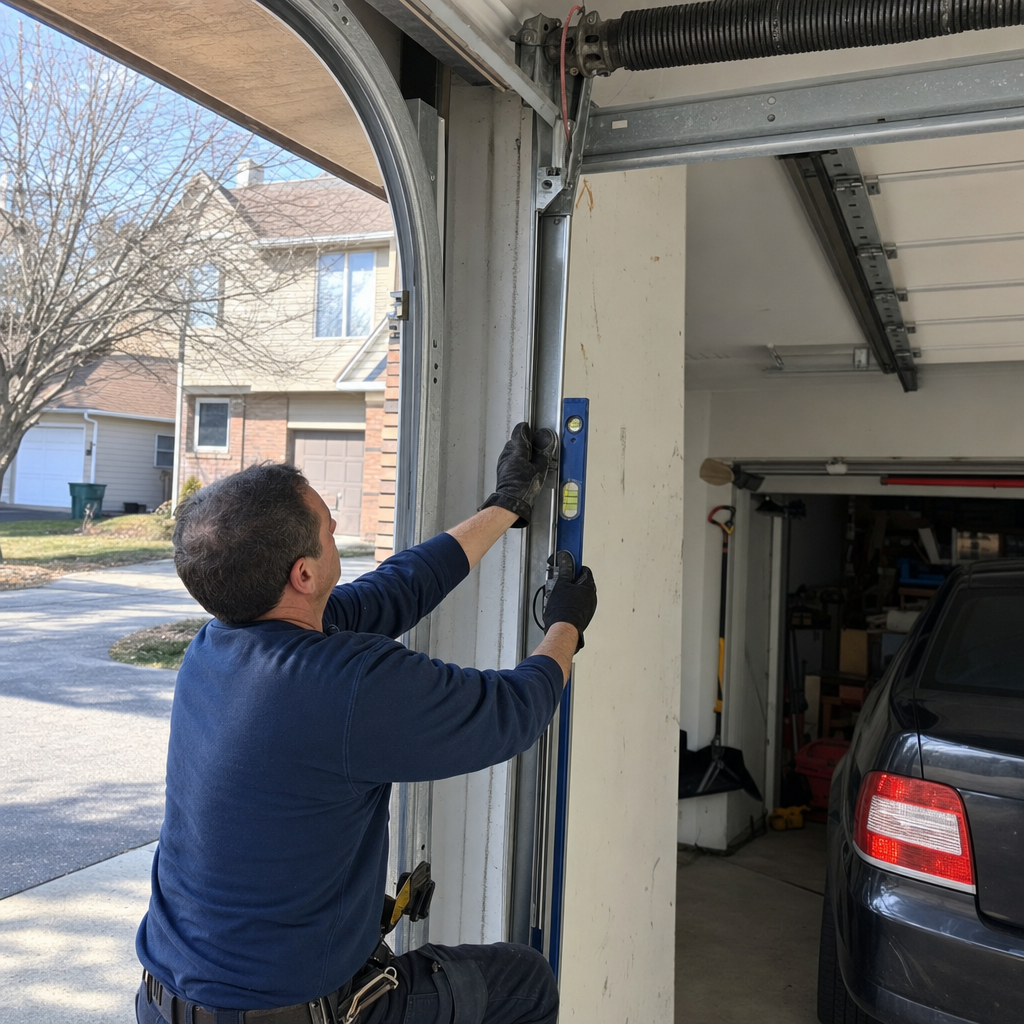
Why Does My Garage Door Reverse in Rochester, NY?
Your garage door reverses because its safety system detects an obstruction it can’t see clearly — in Rochester winters, that’s usually ice buildup on the threshold tricking the door into thinking something’s blocking the path, not a broken opener or misaligned sensor. The reversal is the door doing exactly what it’s designed to do; the problem is what it’s “seeing.” If clearing the threshold and wiping the sensor lenses doesn’t stop the reversal, the close-force or limit settings may have drifted after hard freeze cycles and need professional adjustment. Call (855) 595-1795 for a same-day diagnostic — we’ll tell you what it’s doing and what it needs.
Last January, Daniel got a call from a homeowner in the 19th Ward whose door had been reversing for three days. They’d already watched two YouTube videos, tweaked their opener’s down-limit screw twice, and were halfway through realigning the sensors when they realized the door worked perfectly at 2 p.m. but reversed every time at 7 a.m. The culprit? A half-inch ridge of refrozen meltwater along the garage floor where the rubber seal met concrete — invisible in dim morning light, gone by afternoon sun. Five minutes with a scraper and a dry rag, problem solved. That’s the thing about Rochester: our Lake Ontario snow belt throws conditions at garage doors that inland manuals don’t account for. Nearly 100 inches of annual snow, freeze-thaw cycles that can swing 40 degrees in 48 hours, and wet, heavy accumulations that turn to ice overnight — your door’s reversal logic wasn’t built for this, but local technicians are.
How Garage Door Reversal Actually Works
Every modern garage door opener manufactured after 1993 has two independent systems that can trigger reversal: photoelectric sensors (the two small boxes near the floor, usually with indicator lights) and the opener’s internal force-sensing logic. When the door descends, the sensors shoot an invisible beam across the opening. Break that beam, and the door reverses immediately. If the beam stays clear but the door meets unexpected resistance — a basketball, a patch of ice, a warped section of track — the motor’s torque monitor detects the load spike and reverses the door.
Both systems are federally mandated safety features. Disabling either one, or cranking the close-force setting high enough to override it, means a 400-pound door can close on a child, a pet, or your car’s trunk without stopping. We’ve seen homeowners in Greece and Irondequoit “fix” their reversal problem by turning the force adjustment until the door powers through anything — and then call us two weeks later with a bent top section or a stripped gear. The reversal isn’t the disease. It’s the symptom. Our job is reading it right.
The Three Real Causes of Reversal in Rochester Winters
Through 14 years and hundreds of doors across Monroe County, Daniel has tracked the same three winter reversal patterns, in this order of frequency. Each looks similar from the homeowner’s perspective — door goes down, door comes back up — but the diagnostic check and the fix are completely different.
Threshold Ice Triggering the Obstruction Sensor
This is the big one from November through March. Lake-effect snow melts on your warm garage floor during the day, flows to the lowest point — the seam between your bottom seal and the concrete — and refreezes into a hard ridge overnight. When the door descends the next morning, that ridge creates just enough resistance to spike the motor’s torque monitor before the seal ever touches flat concrete. The opener thinks it’s hit an object. It reverses.
How to tell: The door reverses the instant the bottom seal makes contact, or within the last 6–12 inches of travel. It doesn’t reverse high in the opening. The problem is worse at 6 a.m. than at noon. If you can see a faint white line or feel a bump with your boot where seal meets floor, you’ve found it.
The check: Clear the threshold completely — scraper, then dry towel. Run the door. If it closes fully, ice was your culprit. To prevent recurrence, check that your bottom rubber seal isn’t cracked or gaping; Lake Ontario’s wet snow destroys seals faster than inland climates, and a worn seal lets meltwater pool where it shouldn’t. Garage Door Repair services in Rochester include seal replacement when the rubber has hardened or torn.
Frosted or Condensation-Caked Sensor Lenses
The photoelectric sensors sit 4–6 inches off the floor — right in the zone where cold concrete meets slightly warmer air, creating persistent condensation. Add a Rochester freeze-thaw cycle, and that condensation turns to frost on the lens faces. The beam weakens or scatters. The opener reads “obstruction” and reverses the door, even though nothing’s in the opening.
How to tell: The door reverses before reaching the floor — sometimes at mid-height, sometimes with a foot or two still to go. The opener light may flash in a specific pattern. On LiftMaster and Chamberlain units, a properly aligned sensor shows a solid amber or green LED on the sending eye and a solid green on the receiving eye. If either light is blinking, dim, or out entirely, the beam isn’t making a clean connection. Frost on the lens often looks like a faint haze you wouldn’t notice unless you’re looking for it.
The check: Wipe both lenses with a dry cloth — not your thumb, which leaves oils. Don’t adjust the sensor brackets yet; misalignment is actually less common than lens contamination in our climate. After wiping, check the LEDs. Solid green on both? Test the door. Still blinking? Then you may have alignment or wiring issues, and that’s when a trained eye saves time.
Close-Limit Setting Drifted After Hard Freeze
The opener’s down-limit switch tells the motor when the door has reached fully closed position. In extreme cold, the metal components of your door system contract slightly — tracks, rollers, springs all shrink a fraction. The door physically sits a half-inch higher on the closed position than it did in August. The opener, still programmed for the summer position, drives the motor a half-inch past where the door can actually go. The torque monitor reads resistance and reverses.
How to tell: The door reaches what looks like fully closed, then immediately reverses — or it closes completely on warm days but reverses on single-digit mornings. The sensors are clean, the threshold is clear, but the reversal happens at the very end of travel with a slight mechanical strain you can hear.
The critical distinction: This is the one reversal cause where DIY adjustment is genuinely risky. The down-limit and close-force controls are adjacent on most openers — Chamberlain, LiftMaster, Genie, Raynor, they all cluster them on the motor housing. Turning the wrong screw, or turning the right screw too far, disables the safety function that just saved your door from crushing something. We’ve rescued more than one homeowner in Webster or Penfield who got them backwards. If you’re not absolutely certain which adjustment does what, call someone who offers the Best Garage Door Repair in Rochester, NY and does this daily. A 5-minute diagnostic visit runs $150–$600 depending on what we find; an emergency room visit or a crushed car door costs more.
Reading Your Opener’s Diagnostic Lights
Modern openers flash their overhead light or the sensor LEDs in specific patterns to tell you what’s wrong. Knowing what you’re seeing gets you to the right fix faster — or tells you it’s time to hand it off.
- LiftMaster / Chamberlain (manufactured 2010–present): One flash = sensor wire disconnected or shorted. Two flashes = sensor beam obstructed or misaligned. Four flashes = sensor eyes slightly misaligned (beam weak but not broken). Steady sensor LED on receiving eye = aligned; blinking = problem. The sending eye stays amber solid regardless.
- Genie IntelliG / ChainGlide: Red LED on powerhead blinks once for sensor obstruction, twice for door travel exceeded programmed limits, three times for wall button short. Sensor LEDs: both solid red = aligned; one or both off = wiring or alignment issue.
- Raynor Admiral / Commander series: Similar to LiftMaster patterns (same parent manufacturer) but with a longer flash interval. The “learn” button color matters — purple, red, yellow, and green buttons correspond to different radio frequencies and slightly different diagnostic logic.
If your opener is pre-2010 and lacks LED diagnostics, you’re working with audible clicks and manual observation. That’s not a disadvantage — those units are often simpler to troubleshoot — but it does mean there’s less margin for interpretation error. Daniel still services plenty of these in Corn Hill and Park Avenue carriage houses where the original opener has outlasted two replacement doors.
When Reversal Means Call a Technician
There’s a clear line between homeowner maintenance and professional service. Here’s where we draw it based on 14 years of calls:
| Symptom | Safe DIY Check | Call (855) 595-1795 |
|---|---|---|
| Door reverses on floor contact, morning only | Clear ice, dry threshold, inspect seal | Seal replacement, threshold leveling, or track adjustment if seal won’t seat flat |
| Door reverses mid-travel, sensor LED blinking | Wipe lenses, check for spider webs or debris | Sensor realignment, wiring repair, or logic board diagnosis if LEDs don’t respond |
| Door reverses at closed position, cold days only | Visual inspection for binding or track gaps | Limit/force adjustment, spring tension check, or track realignment ($120–$240) |
| Door reverses intermittently, no clear pattern | Note timing, temperature, and frequency | Full system diagnostic — likely electrical or mechanical wear |
| Door won’t stay down even with sensors disconnected | Do not disconnect sensors — this is unsafe | Immediate service — opener logic board or force setting failure |
The last row matters. We’ve had homeowners in Greece and Irondequoit bypass their sensors “just to get the door closed” until we could arrive. Don’t. Those sensors exist because garage doors killed children before they were mandatory. If your door won’t operate safely, leave it open or prop it manually and call for emergency garage door service. We’ll prioritize it.
What Professional Reversal Repair Costs in Rochester
Most reversal diagnostics fall within our standard garage door repair range of $150–$600. Here’s how typical reversal-related services break down:
| Service | Price Range | When Needed |
|---|---|---|
| Diagnostic & minor adjustment (limit, force, sensor alignment) | $150–$250 | Ice cleared, sensors clean, but settings need calibration |
| Sensor replacement or wiring repair | $130–$250 | Sensor housing cracked, wiring chewed or corroded, LED dead |
| Bottom seal replacement | $110–$220 | Rubber hardened, torn, or improperly fitted — causing ice pooling |
| Track realignment | $120–$240 | Track gap or twist causing binding that mimics obstruction |
| Opener repair (logic board, gear assembly) | $120–$320 | Diagnostics point to internal opener failure, not mechanical |
| Opener replacement | $250–$550 | Unit pre-2000, parts obsolete, or multiple failures |
We don’t quote over the phone for reversal issues because the same symptom covers five different fixes. What we do guarantee: Daniel shows up personally, diagnoses in 10–15 minutes, explains what he found before touching tools, and gives you a fixed price before starting work. No “trip charge plus hourly” surprises. Our home page has more on how we structure visits.
Why Rochester’s Climate Makes Reversal Diagnosis Different
Here’s the Information Gain most national garage door articles miss entirely: Rochester’s combination of lake-effect volume and rapid refreeze creates reversal causes that don’t exist in Syracuse’s drier cold or Albany’s milder winters.
In a typical January, we’ll see a hard freeze follow a 35-degree rain-on-snow event. The meltwater finds every crack in your garage’s perimeter seal, pools at the low point of your sloped concrete floor, and flash-freezes into a ridge that your door’s bottom seal can’t compress. The opener’s torque sensor — calibrated for a clean seal compression — reads that ridge as a 20-pound obstruction and reverses. A technician in Buffalo sees similar snow volume but different refreeze timing; a technician in Binghamton sees refreeze but rarely the wet, heavy lake-effect accumulation that creates the ridge in the first place.
This is why local experience matters for what seems like a generic problem. Daniel knows that a reversal call from Swillburg in late January is ice until proven otherwise; a reversal call from a 1970s ranch in Webster in October is almost never ice and almost always sensor alignment or opener wear. That contextual shortcut gets you fixed faster.
Same with housing stock. Those late-Victorian detached garages in Corn Hill and the 19th Ward? Often built with 8-foot single-car openings and converted to storage or workshop use. The door may be a modern 9-foot replacement squeezed into an 8-foot frame with adapted hardware — and that adapted hardware binds in cold weather differently than standard track. A franchise tech with a standard parts van might replace your opener when the real problem is track geometry. We’ve seen it.
Key Takeaways
- Reversal is safety logic working correctly — never bypass it.
- In Rochester winters, check threshold ice before adjusting anything.
- Sensor lens frost is the #2 cause; wipe before realigning.
- Limit/force adjustments require certainty — wrong turns disable safety.
- LiftMaster and Chamberlain blink their sensor LEDs in specific diagnostic patterns — learn your pattern before calling.
- Same-day diagnostics from Guardian run $150–$600 with upfront pricing.
FAQs
The door’s safety system is detecting something invisible to you — most often ice on the threshold, frost on the sensor lenses, or a limit setting that’s drifted after temperature swings. In Rochester’s Lake Ontario snow belt, threshold ice is the single most common cause from December through March. Clear the floor seam with a scraper, wipe both sensor lenses dry, and test again. If the reversal continues, the close-force or down-limit setting needs professional calibration — call (855) 595-1795 for a same-day diagnostic.
Most reversal issues resolve within our standard garage door repair range of $150–$600. Simple ice clearing and sensor cleaning you can do yourself; professional limit adjustment, sensor realignment, or seal replacement typically runs $150–$250. If the opener’s logic board or gear assembly has failed, repair runs $120–$320 and replacement $250–$550. We quote fixed prices after diagnosis, not vague estimates. Call (855) 595-1795 for an exact quote — estimates are free.
You can safely check for ice on the threshold and wipe sensor lenses — those two steps solve most Rochester winter reversals. Do not adjust the close-force or down-limit screws unless you’re certain which is which; these controls are adjacent on most Chamberlain, LiftMaster, Genie, and Raynor openers, and confusing them disables the safety system on a 400-pound door. If ice clearing and lens wiping don’t resolve the reversal, call a technician. Guardian’s owner-led service means Daniel handles the diagnostic personally — not a subcontractor learning on your door.
Cold causes metal contraction in tracks, rollers, and springs, which changes where the door physically stops versus where the opener expects it to stop. Meanwhile, freeze-thaw cycles create threshold ice and sensor lens condensation that don’t exist above 40 degrees. In Rochester’s climate, a door that reverses only below 20 degrees almost always has a cold-specific cause — ice, frost, or thermal contraction — not a random malfunction. Document the temperature pattern when you call; it speeds diagnosis considerably.
The reversal itself isn’t dangerous — it’s the safety system protecting you. What’s dangerous is bypassing that system or cranking the close-force setting to override it, which we’ve seen homeowners do out of frustration. A garage door that won’t stay down needs diagnosis, not force. If you can’t identify and clear the cause within 10 minutes of basic checks, leave the door in its safest position and call for service. Guardian offers Emergency Garage Door Repair in Rochester, NY when your home’s security or access is compromised.
If you’d rather have it looked at, Guardian Garage Door Repair Greater Rochester offers a no-pressure assessment in Rochester — call (855) 595-1795. Daniel still runs the diagnostics personally, and if we can’t fix it, you don’t pay for the guesswork.
Written by Daniel Lopez, Owner & Lead Technician at Guardian Garage Door Repair Greater Rochester, serving Rochester, NY.